Verdict: origin is a risk profile, not a quality label
Where cabinetry is manufactured does not determine how good it is, but it does determine what can go wrong and how fast it can be fixed. Three origin categories cover the market - domestic, imported RTA wholesale, and European luxury - and each carries a distinct profile across tariff exposure, lead time, price stability and replacement parts. Choosing between them is choosing which of those four risks you would rather own. The Catawba Valley market prices all three, so the comparison is available locally rather than theoretical.
The matrix, read as four separate columns
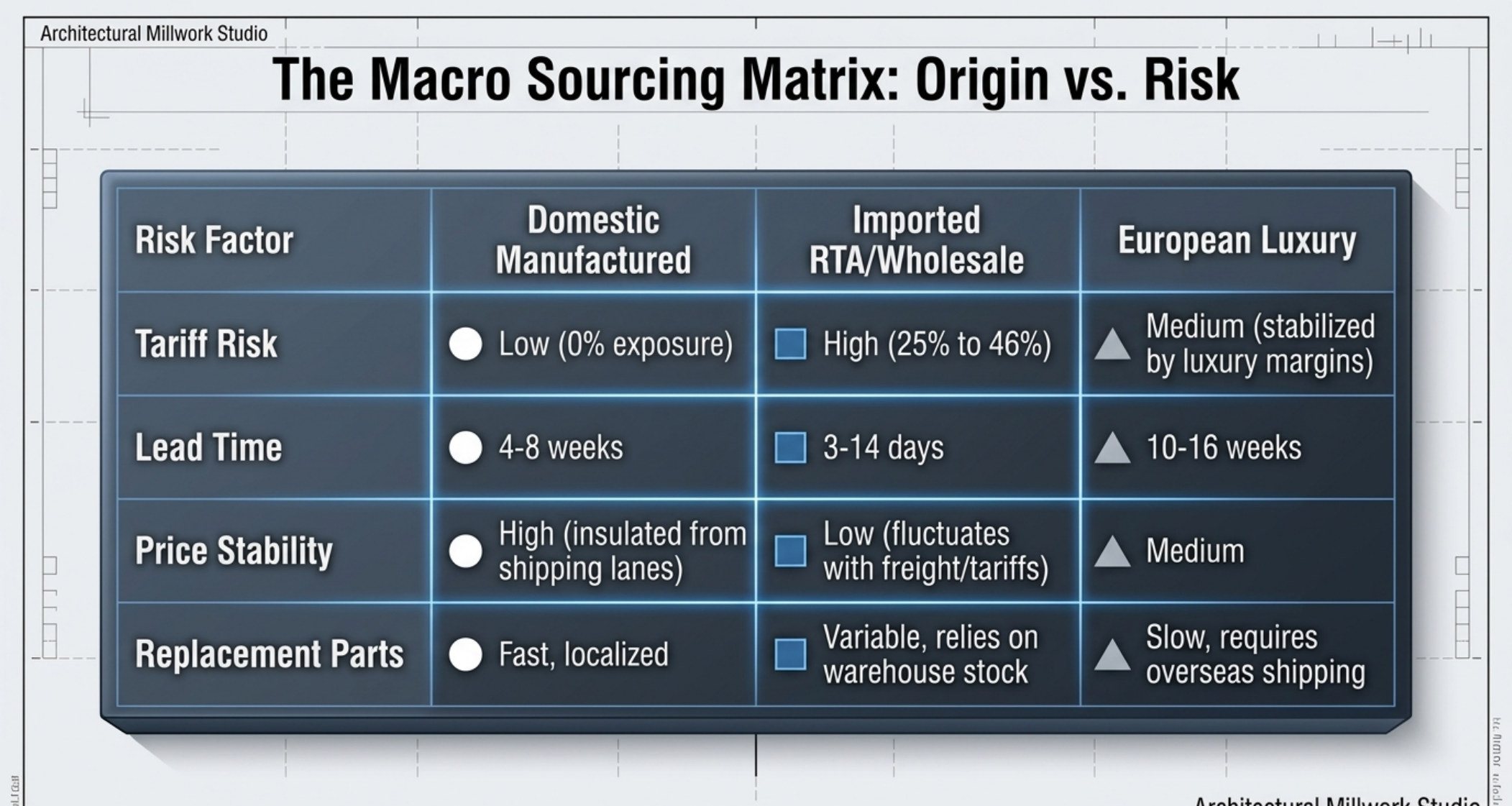
The deck's macro sourcing matrix is deliberately not a ranking. Domestic production scores best on tariff exposure (0%) and price stability; imported RTA wins lead time at 3-14 days; European luxury sits in the middle on tariff because its margin absorbs the duty. Read the columns independently, because a line that wins on lead time can lose badly on parts, and the two costs land in different years.
| Risk factor | Domestic manufactured | Imported RTA / wholesale | European luxury |
|---|---|---|---|
| Tariff risk | Low — 0% exposure | High — 25% base, combined rates approaching 46% from major hubs | Medium — stabilised by luxury margins |
| Lead time | 4–8 weeks | 3–14 days shipping, plus on-site assembly | 10–16 weeks |
| Price stability | High — insulated from shipping lanes and tariff notices | Low — fluctuates with freight and trade policy | Medium |
| Replacement parts | Fast and localised | Variable — depends on warehouse stock of that batch | Slow — requires overseas shipping |
Deck baseline: a standard $3,000 wholesale stock package now runs $3,750-$4,200 under the 2026 tariff measures.
Why replacement parts deserve their own column
Replacement parts are the least-discussed and most expensive risk in the matrix. A kitchen is a long-life purchase and every component in it will eventually need service: a glide fails, a hinge loses its soft-close, a shelf sags, a door is damaged during a later plumbing job. If the part is sourced locally the repair is an appointment; if it depends on a shipment the repair is a project; in the worst case the whole unit is replaced because a single component no longer exists.
| Component failure | Domestic part supply | Imported part supply | Realistic resolution time |
|---|---|---|---|
| Glide or hinge failure | Stocked locally; fitted on a service visit | Depends on batch availability in a local warehouse | Days vs weeks |
| A single damaged door | Re-made in the shop that built it | Re-ordered; may not match the original batch | Days vs a possible mismatch |
| A batch-specific finish touch-up | Matched from the original finish records | Depends on whether the line is still in production | Immediate vs indefinite |
| A swollen box panel | Replaced with plywood locally | Both the part and the substrate are the problem | Solved vs a new kitchen |
This is the column that decides total cost of ownership rather than purchase price.
The cost model, with the arithmetic shown
Tariff exposure is easy to price because it is a percentage on a known base. A $3,000 wholesale package carries a 25% base rate under the 2026 measures: $3,000 x 1.25 = $3,750. At the top of the range the deck cites, 46%, the same package lands at $3,000 x 1.46 = $4,380. The difference between the two outcomes is $630 on one package, before freight, and it is not a price the buyer sets - it is a trade position that can move between quotation and order.
Compare that with the same money spent domestically. The installed bands for this market are $150-$400 per linear foot for stock or RTA and $500-$1,200 for full custom, so a 20-foot run is 20 x $275 = $5,500 at the stock midpoint against 20 x $850 = $17,000 at the custom midpoint. The tariff exposure on the imported side is a percentage of the cheaper number; the domestic premium is the whole difference - and it buys 0% exposure, delivery in 4-8 weeks instead of 10-16, and parts measured in driving distance rather than shipping lanes.
| Buyer priority | Best-fit origin | Accept the trade-off | Worst fit |
|---|---|---|---|
| Certainty of final price | Domestic manufactured | Higher unit price, longer schedule | Imported RTA, where freight and tariff can move the number |
| Speed to installation | Imported RTA / wholesale | Assembly labour on site and tariff exposure | European luxury at 10–16 weeks |
| Long-term serviceability | Domestic manufactured | Lead time and unit cost | Imported lines whose batches rotate |
| A specific aesthetic unavailable locally | European luxury (or a domestic hybrid) | Long lead time and premium pricing | Forcing a domestic line to imitate a system it was not built for |
The matrix does not rank the columns. It shows which risk each column charges.
Failure and maintenance: the truth table
Origin changes what a failure costs, not whether one happens. The table below prices the same five events across the three origins, using the lead times in the deck's matrix and the freight exposure described above.
| Event | Domestic line | Imported RTA line | European luxury line |
|---|---|---|---|
| A damaged door front on arrival | Re-made in 1-2 weeks on a local bench | Re-shipped with the next container, 3-6 weeks | Ordered from the brand's factory, 10-16 weeks |
| A glide loses soft-close in year 5 | Branded part sourced locally, days | Part may be unbranded and out of production | Brand supply chain, 4-8 weeks |
| A box edge swells in the humid season | Local shop replaces the box | Box and front often replaced as a set | Specialist fitter required by warranty terms |
| A shelf sags under load | New shelf cut to size | Await a replacement from warehouse stock | Ordered as a branded component |
| Whole-run re-specification after a bad build | Re-quoted locally, no import exposure | New container, new tariff basis | New project, new 10-16 week window |
The pattern is that lead time and repair time are different quantities. Imported RTA is the fastest to arrive and the slowest to repair; European luxury is slow on both ends but insulated by margin; domestic is neither fastest nor cheapest and wins the year-five column that no showroom quote prints.
Calibrated to Hickory and the Catawba Valley
This region has an unusual advantage in the origin decision: the domestic option is not an abstract category here. Catawba County's first furniture factory opened in 1902, and the state's commerce department still describes Hickory as the furniture capital of the world, with triple the national average of furniture-manufacturing activity and the largest workforce in the country. A dense local millwork trade is what makes the 4-8 week domestic band achievable rather than aspirational - the deck states it plainly: these cabinets are not shipped on a container, they are milled and built by professionals who understand the regional climate.
That climate is the second local input and it argues the same way. Hickory averages 67% relative humidity, peaking near 74% in August, with the muggy window running roughly four months from late May into September. A package that crosses an ocean and then sits in a warehouse reaches equilibrium with a different humidity band than the one it will live in, and the failure shows up at the cut edge rather than the face. Local production calibrates to the band the cabinetry actually occupies, and it keeps the parts loop short: a swollen box in year four is a bench visit, not a freight decision. The tariff clause audit is the third local lever - name the origin and the pricing basis on every quote, because that single line converts an invisible risk into a negotiated one.
Decision matrix: choose the origin by the risk you can carry
- Choose domestic manufactured if your budget cannot absorb variance: 0% tariff exposure, 4-8 week delivery and local parts make the quote the most likely to hold.
- Choose imported RTA if speed to first install is the binding constraint and the run is a rental-grade or short-life application where year-five parts will never be called for.
- Choose European luxury if a specific handleless or integrated composition is the requirement and you accept 10-16 weeks plus a factory-ordered parts channel.
- Choose a domestic European-style build if you want the look but not the schedule - a local shop can build slab fronts and integrated pulls inside the 4-8 week band.
- Walk away from any quote if the origin and pricing basis are unnamed, because an unnamed basis means the price can be re-set between signature and delivery.
Contractor spec handoff checklist
Give this to each shop quoting the job and ask for it back on the quotation. It is the difference between comparing three prices and comparing three risk profiles.
- Country of manufacture named for boxes, doors, drawer boxes and hardware, not just for the brand.
- Tariff and pricing basis stated: fixed price, or indexed to the current duty position, in writing.
- Delivery window given in weeks, plus the delivery window for a single replacement component.
- Replacement-part sourcing path named, with a stated response time for one door and one glide.
- Plywood or composite core confirmed for every box, with kiln-dried stock named for doors and fronts.
- Freight and duty shown as separate lines on the quote rather than folded into the unit price.
- Drawer and hinge hardware brand and model recorded, so a future part can be ordered by number.
- Written warranty terms naming who performs service work and where parts ship from.
Put those eight lines in front of three shops and the import-versus-domestic question stops being philosophical: it becomes a set of dates and a parts path, priced.
Sources
Figures in this article come from the "2026 Cabinet Market Intelligence" deck slides (macro sourcing matrix: tariff risk, lead times of 4-8 weeks domestic, 3-14 days imported RTA and 10-16 weeks European; the $3,000-to-$3,750-4,200 tariff example), the site's own installed cost bands ($150-$400 stock / RTA, $500-$1,200 full custom per linear foot), Hickory climate normals (67% mean relative humidity, 74% August peak), and North Carolina Department of Commerce / Catawba County furniture-industry reporting.
Ready to Talk to a Local Cabinet Pro?
Get free, no-obligation quotes from pre-vetted Hickory cabinet professionals — licensing, insurance and references checked before you are introduced.
Get Matched in Hickory →