Verdict: grades are relative, and value peaks in the middle
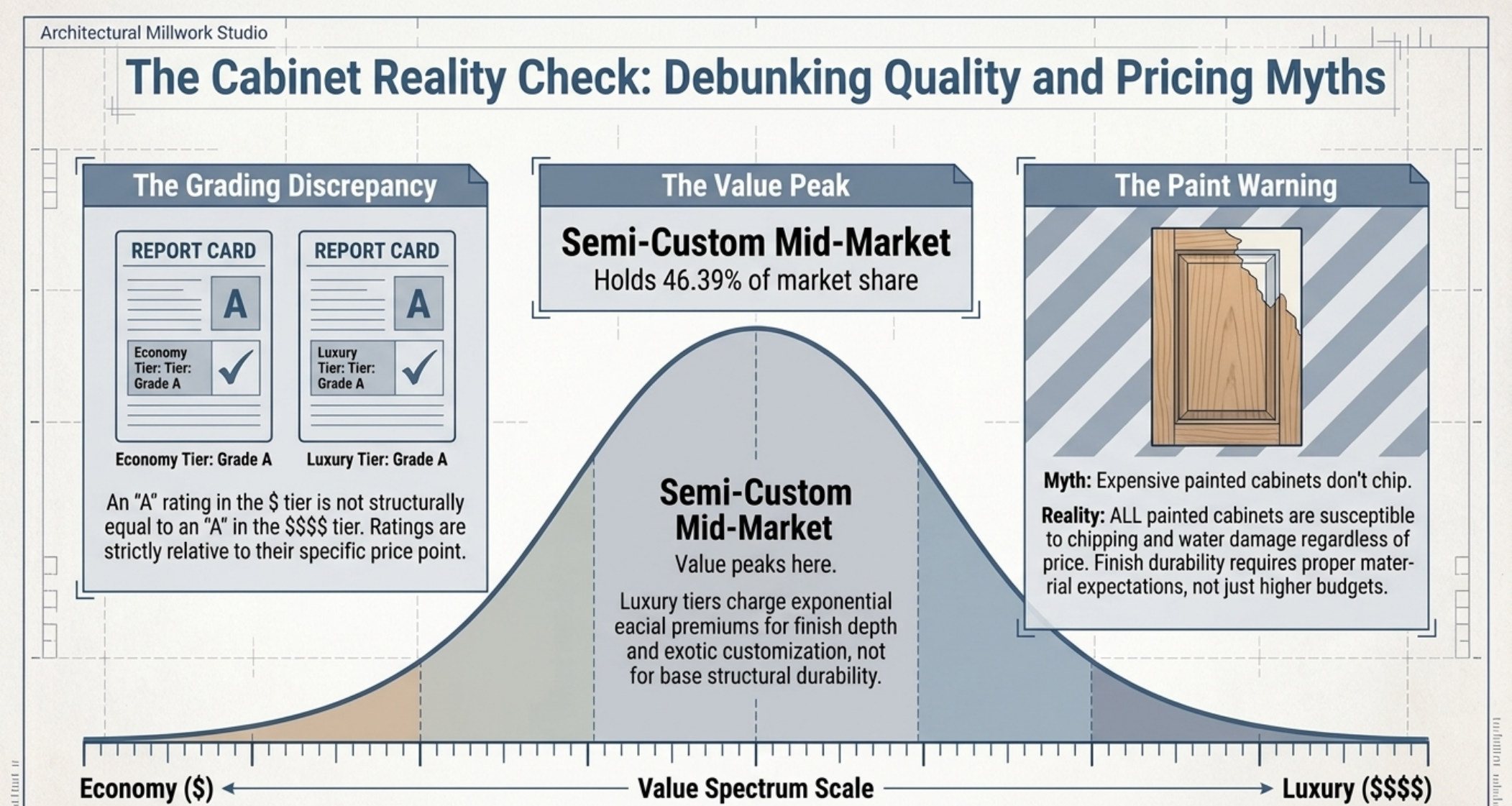
A cabinet line graded A at an entry price and a line graded A at a luxury price are not the same product, even though both carry the same grade. Ratings are relative to their own price point, so a grade tells you how a line performs against its peers, never against a better tier. In this market the semi-custom mid-market holds 46.39% of the total, and that share is the clearest published signal of where value sits. The number worth carrying into a showroom is not the letter, it is the price per linear foot the letter is attached to.
What an "A" actually certifies, tier by tier
An "A" in the economy tier and an "A" in the luxury tier are graded on different scales, so the same letter describes different construction. Read the letter as a within-tier rank and the premium as a separate question. The only question that survives the trip home is whether the money between two tiers buys a structural improvement or a finish improvement.
| Tier | What an “A” grade means here | What the price premium buys | Is the premium structural? |
|---|---|---|---|
| Economy | Best in class at its price point | Entry construction and standard hardware | No — it is a price-point grade, not a durability grade |
| Semi-custom mid-market | Best in class at its price point | Flexible sizing, finish choice, plywood and full-extension glides on upper lines | Partly — this is where construction normally improves |
| Luxury | Best in class at its price point | Finish depth, exotic materials and bespoke customisation | No — premiums buy finish depth and customisation, not base structural durability |
Deck baseline: an "A" in the entry tier is not structurally equal to an "A" in the luxury tier. Ratings are strictly relative to their own price point.
The paint warning that no tier resolves
One claim survives every price point, and it is the one homeowners resist: all painted cabinets are susceptible to chipping and water damage regardless of price. Paint sits on the surface as a film, while stain absorbs into the grain. The film is the vulnerable part, and a bigger budget buys depth of colour and consistency rather than an indestructible surface. Touch-up belongs in long-term kitchen maintenance at every tier; it is not a sign that a line was cheap.
| Claim | Reality | What to budget for instead |
|---|---|---|
| “Expensive paint does not chip” | All painted cabinets chip, scratch and show water damage over decades of daily use | Touch-up materials and a repaint cycle |
| “Premium tiers are structurally stronger” | Luxury premiums buy finish depth and exotic customisation, not base structural durability | Better boxes, hinges and glides at whichever tier you buy |
| “Budget lines are unreliable” | An economy line can be best-in-class at its price point | Specification discipline: substrate, joinery and hardware named in writing |
| “Semi-custom is a compromise” | It holds 46.39% of the market because it balances customisation and control | Spend the surplus on the parts of the job that carry load |
The correct expectation for painted cabinetry is maintenance, not permanence - at every price.
The cost model, with the arithmetic shown
Use the installed bands this market already quotes: stock or RTA at $150-$400 per linear foot, semi-custom at $350-$650 and full custom at $500-$1,200. Take the midpoint of each band ($275, $500 and $850) and price a 20-foot run of base and wall cabinets. Stock is 20 x $275 = $5,500. Semi-custom is 20 x $500 = $10,000. Full custom is 20 x $850 = $17,000. The first step adds $4,500 to buy flexible sizing and finish choice; the second adds $7,000 more, a further 70% over the mid-market.
That step is the arithmetic behind the value peak. If the layout already works, the $7,000 spent moving past the mid-market buys the appearance of a tier rather than a longer service life - and the paint warning applies on both sides of it. A 20-foot run also fixes the maintenance budget: touch-up for every painted door, replacement for any edge that is composite.
| Budget line | Where the money is wasted | Where it buys longevity | Typical effect |
|---|---|---|---|
| Box construction | Upgrading a finish on a composite box | Plywood boxes, kiln-dried hardwood frames | The largest single determinant of service life |
| Drawer boxes | Paying for a brand name on a stapled box | Dovetail drawer boxes | Drawers are the most-used moving part in the room |
| Hardware | Cosmetic pulls at a premium | Soft-close hinges and under-mount full-extension glides | Cheapest upgrade with the highest perceived quality return |
| Finish | Expecting a premium paint to be damage-proof | A finish appropriate to the room and a touch-up budget | Prevents the disappointment that drives premature replacement |
Deck baseline: value peaks at the semi-custom mid-market - above it you buy finish and customisation, below it you buy constraints.
Failure and maintenance: the truth table
Finish failures arrive on a schedule, and the schedule is set by humidity and substrate rather than by price. Three of the six failures below are avoidable by specification; three are not, and they belong in the maintenance budget from day one.
| Failure mode | First appearance | Actual cause | Correction | Avoidable by spending more? |
|---|---|---|---|---|
| Paint chipping at door edges | Year 1-2, high-traffic doors | A film finish on a panel that flexes; the tightest radius chips first | Touch-up pen, then re-spray that door | No - all painted cabinetry, every tier |
| Paint ticking open at a joint | After the first full season | Substrate movement at a glued or stapled joint | Fill and re-spray the joint | Only by substrate choice, not by price |
| MDF door edge swelling | First humid summer (Jun-Sep) | An unsealed cut edge absorbing moisture | Door replacement | Yes - solid hardwood edges |
| Particle-board box swelling | First humid summer | Composite core with sealed faces only | Box replacement, not a re-skin | Yes - plywood boxes |
| Hinge plate losing grip | Year 3-6, after swelling | Fasteners set into a swollen composite panel | Through-bolt, or replace the box | Yes - solid or plywood core |
| Glide losing soft-close | Year 5-8, past 20,000 cycles | Wear in an unbranded mechanism | Replace the glide pair | Yes - branded hardware |
The two paint failures are the price of a painted kitchen at any budget; the four material failures are specification decisions.
Calibrated to Hickory and the Catawba Valley
Catawba County's first furniture factory opened in 1902, and this region is still described by the state's own commerce department as the furniture capital of the world, with triple the national average of furniture manufacturing activity and the largest such workforce in the country. That history is not decoration - it is why the deck's Hickory standard can be stated in three plain lines (solid Appalachian hardwood doors, dovetail joinery, soft-close hardware) and understood by every bench in the county. A trade that has been building case goods here for more than a century already knows what a stable substrate is; the vetting question is whether your shop applies it.
The second local input is humidity. Published normals put Hickory's average relative humidity at 67%, rising to 74% in August, with a muggy window of roughly four months from late May into September and 22 muggy days in July alone. That band is what the cabinetry actually lives in, and it decides which grade matters: a premium that improves finish depth does nothing for edge stability, while kiln-dried stock, sealed cut edges and plywood boxes - all available at the mid-market - decide whether the doors stay aligned in year four. Local sourcing shortens the repair loop too: a part that is milled in the valley is an appointment, while a part that arrives on a shipping schedule turns one failed glide into a waiting project.
Decision matrix: choose the tier by what is actually broken
- Choose stock or RTA if the layout is fixed, the run is short and purely functional, and the cabinet is not expected to outlive the mortgage - it is 20 x $275 = $5,500 for the 20-foot example above.
- Choose the semi-custom mid-market if the layout works but the sizes do not, which is the 46.39% case: it buys flexible sizing and finish choice for $4,500 over stock without paying $7,000 for bespoke architecture.
- Choose full custom if the layout itself is the problem - a wall that is not 36 inches, a slope, a corner that needs a specific box - because no finish upgrade fixes geometry.
- Stay put and reface if the boxes are square and sound but every surface is dated; the reface path sits at roughly half the replacement band and leaves the carcass and its fit untouched.
- Reject any tier if the quote names a grade but not the substrate of the door and the box - a letter without a material list is not a specification.
Contractor spec handoff checklist
Hand this list to every shop you quote, and require it back in writing on the quote itself. It converts a grade conversation into a material conversation in one page, and it is the same list the site's own specification checklist walks through.
- Door substrate named (solid hardwood, plywood or MDF) and edge profile stated as sealed, painted or banded.
- Box substrate named (plywood or composite), with plywood thickness called out.
- Drawer box joinery named (dovetail, dowel or stapled) and drawer bottom material stated.
- Hardware brand and model for hinges and glides, with load rating and cycle rating quoted.
- Moisture content of supplied stock at delivery, and how it is stored on site before install.
- Which tier the load-bearing components come from, separated from the tier the doors and finish come from.
- Touch-up kit included, with the paint or stain code recorded for future repair.
- Replacement-part lead time in writing, so a future repair is measured in days rather than in shipments.
Run the specification past three shops and the quotes become comparable line by line.
Sources
Figures in this article come from the site's own published cost bands ($150-$400 stock, $350-$650 semi-custom, $500-$1,200 custom per linear foot) and market shares, the "Cabinet Reality Check" deck slides (grading discrepancy, value peak, paint warning), Hickory climate normals (67% mean relative humidity, 74% August peak, ~4-month muggy window), and North Carolina Department of Commerce / Catawba County furniture-industry reporting.
Ready to Talk to a Local Cabinet Pro?
Get free, no-obligation quotes from pre-vetted Hickory cabinet professionals — licensing, insurance and references checked before you are introduced.
Get Matched in Hickory →