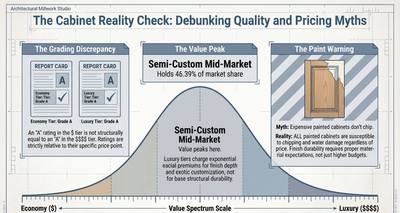
Verdict: local is a cost position, not a sentiment
The argument for locally milled cabinetry in the Catawba Valley is usually made as nostalgia, which wastes it. The real case is arithmetic. A domestically produced line carries 0% tariff exposure; an imported flat-pack carries 25% as a base rate under the 2026 Section 232 measures, with combined rates approaching 46% from major import hubs. A stock package that used to wholesale at $3,000 now runs $3,750-$4,200 before freight. That is not a small adjustment at the top of a quote - on a package that size it is the whole margin, and it is the difference between a quote that holds and a quote that gets re-priced. If you have been weighing up kitchen cabinet installation for a home around Hickory, NC, this guide covers how it actually works, what it tends to cost, and where the results usually fall short.
The risk profile that local production removes
Four columns decide what a cabinet line costs to own, and domestic production leads on three of them. Comparing the same four columns is the comparison that matters, because a line that wins on lead time can lose badly on replacement parts, and the two costs land in different years.
| Risk factor | Domestically manufactured | Imported RTA / wholesale | European luxury import |
|---|---|---|---|
| Tariff risk | Low — 0% exposure | High — 25% to 46% | Medium, stabilised by luxury margins |
| Lead time | 4–8 weeks, scheduled locally | 3–14 days shipping, plus assembly time on site | 10–16 weeks |
| Price stability | High — insulated from shipping lanes and tariff notices | Low — moves with freight rates and trade policy | Medium |
| Replacement parts | Fast and localised; a re-made door is days away | Variable — depends on warehouse stock of that batch | Slow; requires overseas shipping |
Deck baseline comparison: domestic production is the financially stable option, not only the premium one.
Engineered for the climate it lives in
The second advantage is the one buyers feel rather than read on a quote. Local shops engineer for the humidity band the cabinets will actually live in, which here means kiln-dried stock below 10% moisture content, plywood rather than composite boxes, and finished edges that survive a summer. A factory in a different climate calibrates to a different baseline, and the failure shows up at the cut edge rather than in the face.
| Conditioning decision | Regional approach | Why the difference shows |
|---|---|---|
| Moisture content at fabrication | Kiln-dried below 10% for the local humidity band | Wood that arrives at the wrong moisture content moves after installation |
| Box substrate | Plywood throughout; no composite in wet zones | Edges swell and hinge plates lose purchase before the faces fail |
| Joinery | Mechanical dovetails that tighten under load | Glue and staples fail at the corner under sustained weight |
| Finish environment | Applied in a controlled shop, cured before delivery | Site-applied finishes cure slowly and pick up dust in an active garage |
Climate engineering is invisible at hand-over and decides the service life.
The cost model, with the arithmetic shown
Start with the duty, because it is a percentage on a known base. A $3,000 wholesale package at the 25% base rate is $3,000 x 1.25 = $3,750. At the 46% top of the range the same package is $3,000 x 1.46 = $4,380. The spread between those two outcomes is $630 on a single package, and it is set by a trade position rather than by the buyer.
Then price the same wall domestically. Installed bands in this market run $150-$400 per linear foot for stock or RTA and $500-$1,200 for full custom, so a 20-foot run is 20 x $275 = $5,500 at the stock midpoint against 20 x $850 = $17,000 at the custom midpoint. The domestic premium is the $11,500 difference - and what it buys is measurable: 0% duty exposure, delivery in 4-8 weeks rather than 8-12 for a national custom brand or 10-16 for a European system, and parts measured in driving distance. Using the two delivery bands, domestic production lands 4 weeks ahead of a national brand quote and 6-8 weeks ahead of a European system.
Read that as the honest comparison: the import advantage of $3,375 at the 25% rate against domestic stock disappears the moment one door has to be re-shipped, and it reverses at the 46% rate, where the imported package lands at $8,030 against a $5,500 domestic stock run. The duty is the visible part of the import position; the friction below is the part that shows up in daily use.
| Friction point | Local production | Container-shipped package |
|---|---|---|
| A door arrives with a defect | Re-made in the shop, days later | Claim, wait for stock, possibly wait for the next shipment |
| A run is measured 5″ short | Cut and fitted on the next pass | Re-order; the whole run waits on one component |
| Layout changes mid-project | Shop revises the drawings and fabricates | Catalogue limitations; the change may not be possible |
| Five years later, one glide fails | Part sourced locally | Depends entirely on whether that batch is still stocked |
Friction points are where the two routes diverge in daily use rather than on the invoice: the local build's bottleneck is a shop queue that can be visited, and the imported package's bottleneck is a container that has already left the port.
Failure and maintenance: the truth table
Humidity is the failure driver in this valley regardless of origin, so the table below separates what changes when the cabinetry is built locally from what does not.
| Failure | Imported package, container-shipped | Local build | Which is cheaper to own |
|---|---|---|---|
| Door swells at an unfinished edge | Replace the door; 3-6 weeks with a shipment | Plane or replace at the bench; days | Local |
| Box delaminates after a humid season | Box and front arrive as a matched set; wait | Box rebuilt to the existing front | Local |
| Glide or hinge fails in year 5 | Unbranded part may be out of stock | Branded part sourced locally | Local |
| Component damaged during a later plumbing job | Re-order, re-ship, re-fit | Re-made to pattern | Local |
| Whole run re-priced between quote and order | Possible, if the duty basis moves | Fixed price held through the build | Local |
| Small punch list at hand-over | Handled by the delivering shop | Handled by the shop that measured the room | Local, but both are acceptable |
Nothing in that table contradicts the import case on speed: a flat-pack genuinely arrives in days. The point is that the speed advantage applies to the purchase, while the columns that decide ownership cost apply to the following decade.
Calibrated to Hickory and the Catawba Valley
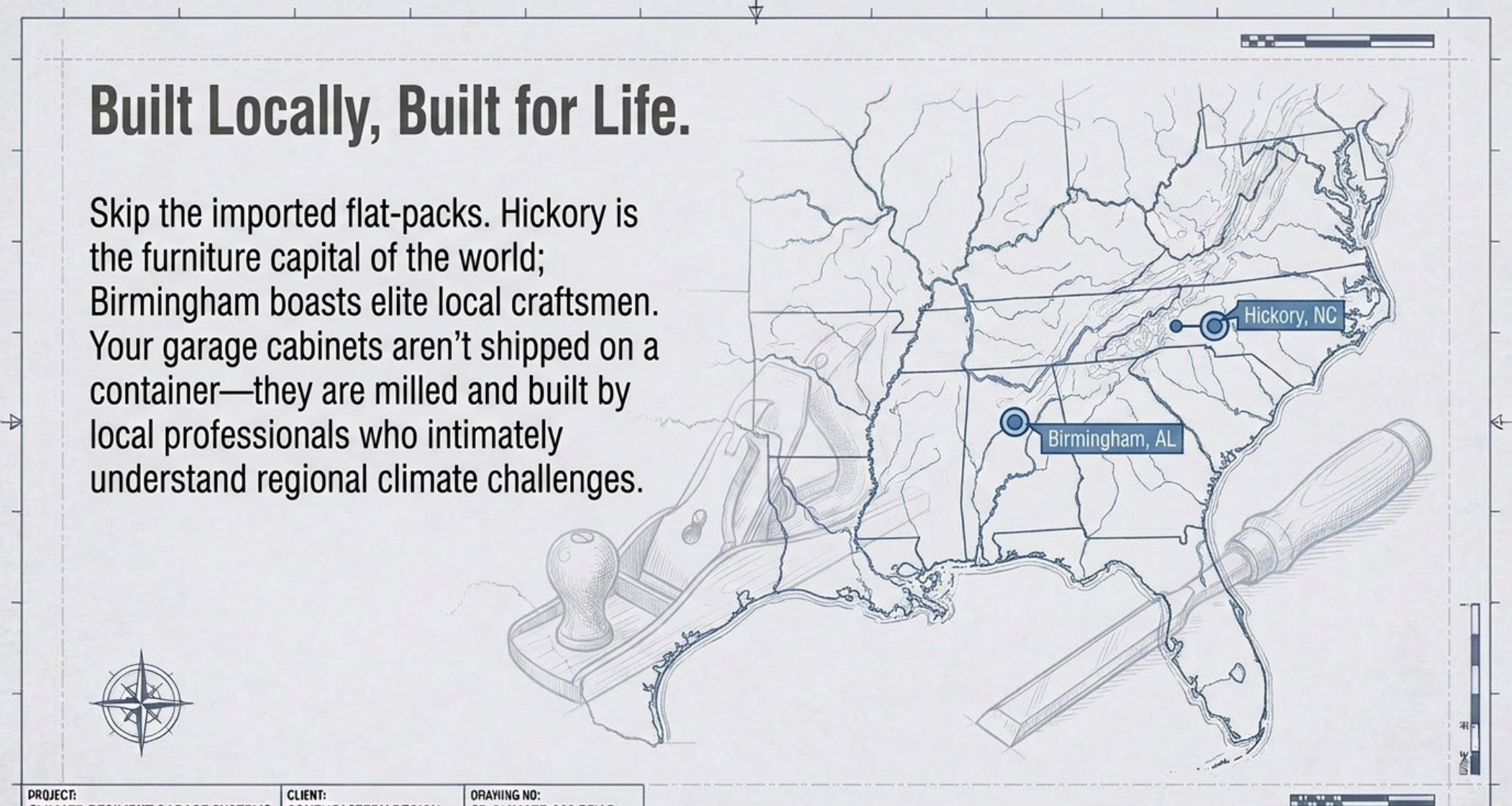
The local trade here is not a marketing claim. Catawba County's first furniture factory opened in 1902, and North Carolina's own commerce department still describes Hickory as the furniture capital of the world, citing triple the national average of furniture-manufacturing activity and the largest such workforce in the country. That density is why the domestic custom band is 4-8 weeks rather than a season, and why a mis-cut component is a bench decision instead of a freight one. The deck's note is blunt about it: these are not shipped on a container, they are milled and built by professionals who understand the regional climate.
That climate is the second calibration. Published normals put Hickory at 67% average relative humidity, peaking near 74% in August, with a muggy window of about four months from late May into September. The local material response is specific to that band: kiln-dried stock below 10% moisture content, plywood boxes instead of composite, sealed cut edges, and hardware specified for a room that swings between damp summers and dry winter air. The third lever is sourcing distance - a locally sourced door blank or drawer box is replaced from a supplier in the region, which is what keeps a repair appointment-sized rather than project-sized.
Decision matrix: choose local or import by what you are buying
- Choose local custom if the cabinetry is permanent, the room is humid-controlled only by habit, and you want year-five service to be local - the $11,500 premium over stock buys parts distance and fit, not decoration.
- Choose domestic semi-custom if you need flexible sizing without bespoke pricing; at 20 x $500 = $10,000 it is the tier that absorbs a non-standard wall.
- Choose imported RTA if the application is short-life (rental, workshop, temporary) and nothing will be called on in year five.
- Choose a European system if the design language is the requirement and you accept a 10-16 week window plus a factory parts channel.
- Do not choose on price alone if the quote does not name the origin and the duty basis; an unnamed basis is the one line that can move after you sign.
Contractor spec handoff checklist
Ask every shop for these lines on the quote, and put the same specification in front of both a local builder and an importer so the comparison is real.
- Origin of boxes, doors and hardware named separately, with the duty basis stated.
- Moisture content of supplied stock at delivery, and how it is stored before install.
- Box core named (plywood or composite) and door substrate named at the cut edge.
- Cut edges specified as banded, sealed or painted, with the sealant named.
- Delivery window in weeks, plus the delivery window for one replacement door.
- Replacement-part source and response time for one glide and one hinge.
- Finish schedule and touch-up kit recorded, including the stain or paint code.
- Price shown as supply, freight, duty and installation lines rather than one number.
Put those eight lines beside an import quote and a local quote and the decision stops being about sentiment: it becomes a landed cost and a parts path, written down.
Sources
Figures in this article come from the "Built Tough: Ultimate Garage Upgrade" deck slide on local millwork and the "2026 Cabinet Market Intelligence" sourcing slide (0% domestic tariff exposure, 25%-46% imported rates, the $3,000-to-$3,750-4,200 package example), the site's own installed cost bands ($150-$400 stock / RTA, $350-$650 semi-custom, $500-$1,200 custom per linear foot), delivery bands of 4-8 weeks domestic and 10-16 weeks European, Hickory climate normals (67% mean relative humidity, 74% August peak, ~4-month muggy window), and North Carolina Department of Commerce / Catawba County furniture-industry reporting.
Ready to Talk to a Local Cabinet Pro?
Get free, no-obligation quotes from pre-vetted Hickory cabinet professionals — licensing, insurance and references checked before you are introduced.
Get Matched in Hickory →