Verdict: five checks, all of them verifiable before deposit
Choosing a cabinet maker in the Hickory area is not a matter of taste. Five checks predict the outcome of the project, and each one can be verified with a document, a public record or a five-second look at a finished drawer. Skip them and the only remaining signal is price - which is the signal that separates the two kinds of shop. None of the five takes more than a few minutes, and together they are the difference between a cabinet project and a cabinet problem.
The five checks and what each one predicts
The list is a sequence, not a wish list. Licensing and insurance are pass-fail gates; material and joinery claims are verifiable in a shop; references are the slowest signal and the easiest to fake. Run them in order and you will usually stop before the fourth.
| Check | Evidence to request | What it predicts | Failure mode if skipped |
|---|---|---|---|
| Active local licensing | Licence number on the written quote, matched to the state board record | Legal standing to contract, and accountability if the work fails | No recourse; the contract may be unenforceable |
| General liability insurance | Certificate naming your project address and dates | Property damage and third-party injury are covered | You claim against your own homeowner policy |
| Workers comp | Certificate, or a valid exemption | A crew injury is not your liability | Medical and wage claims can be pursued against the homeowner |
| Kiln-dried stock, no particle board | Written species and drying standard; a cut edge to inspect | Boxes stay dimensionally stable through the humidity band | Edge swelling, hinge tear-out, box replacement |
| True dovetail joinery | An open drawer with the corner joint visible | Drawers survive sustained load | Corners fail under pot, pan and tool weight |
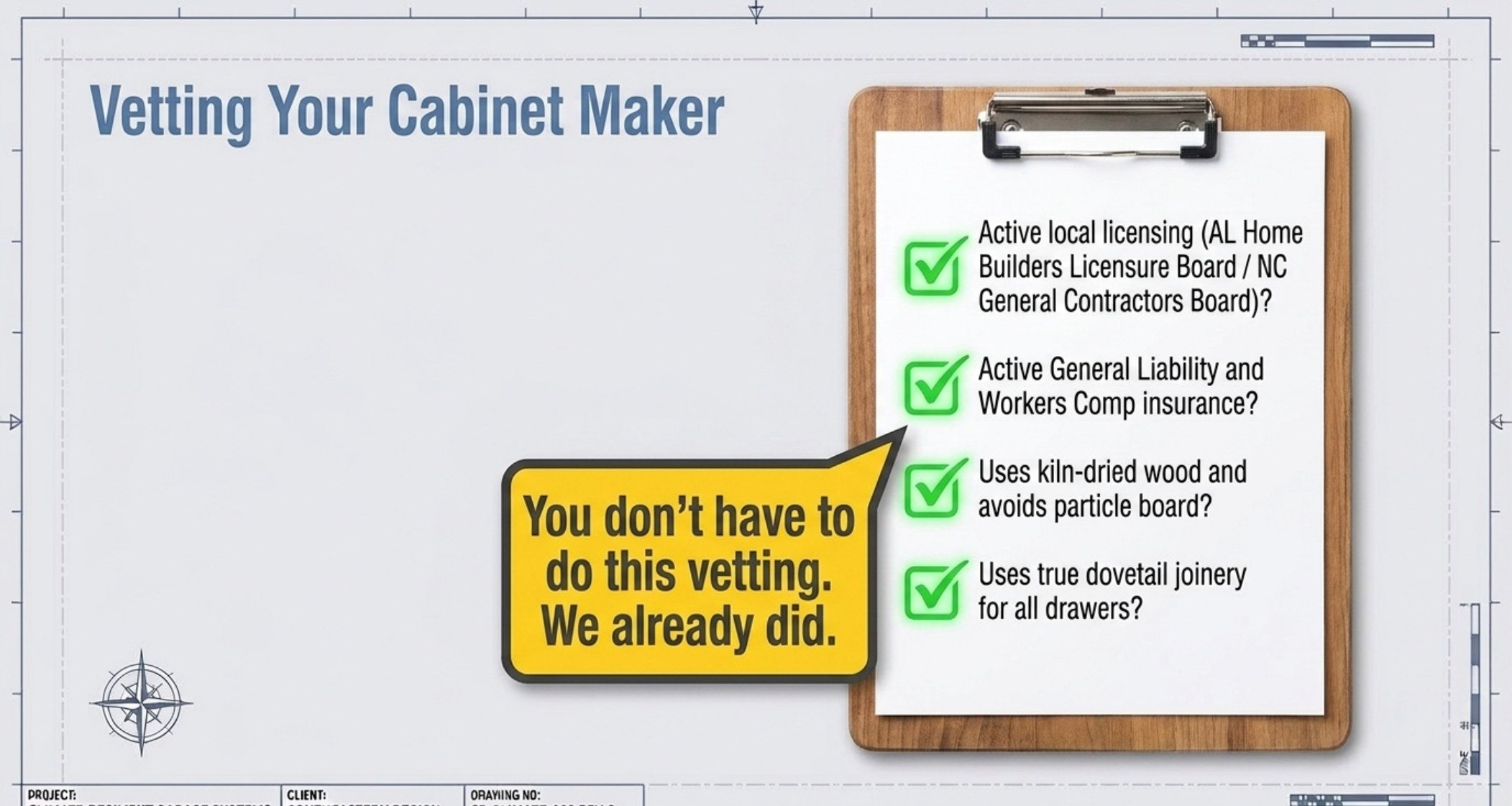
Deck baseline: active local licensing, general liability and workers compensation insurance, kiln-dried wood rather than particle board, and true dovetail joinery for every drawer.
The documents, and how to read them
Vetting is a sequence, not a vibe. Start with the licence number on the written quote and check it against the state board record; the name on the licence must match the name on the contract. Then ask for a certificate of insurance showing general liability coverage with your project address and dates, and call the broker number printed on it rather than a number the shop supplies. Then ask for workers compensation proof or a valid exemption. Only after those three are in hand is it worth discussing construction standards, because a shop that cannot produce credentials on request is a shop whose material claims cannot be verified either.
| Document | What it must show | How to verify | Red flag |
|---|---|---|---|
| Licence | The shop’s legal name and an active status | State board public record | A number that is expired or belongs to another entity |
| General liability certificate | Your address, your project dates, adequate limits | Call the broker printed on the certificate | A generic photocopy with no address |
| Workers comp certificate | Active coverage, or a valid written exemption | Call the insurer | “The crew are all subcontractors” with no certificates |
| Written scope | Materials, joinery and hardware named | Compare against the specification you asked for | Vague material language such as “quality wood” |
Credentials first, materials second - the order matters, because each step tells you whether the next answer is worth gathering.
The cost model, with the arithmetic shown
The five checks cost nothing but a few phone calls, and the failure they prevent has a price that can be read off the market's own bands. Installed cabinetry runs $150-$400 per linear foot at stock level and $500-$1,200 at full custom, so a 20-foot run is 20 x $275 = $5,500 at the stock midpoint against 20 x $850 = $17,000 at the custom midpoint. The $11,500 difference is the size of the bet being placed when a shop is chosen on price alone.
Now price the failure. A rebuild at year six costs the full band again - the $17,000 run becomes $34,000 across two builds, and the second one arrives with the room out of service for another 4-8 weeks. A single substituted component is cheaper but still disproportionate: a particle-board box that swells takes its door with it, and replacing one box and its front is priced as a bench job against the $1,175 that a 10% discount removed at order. Verifying a licence and an insurance certificate is free; a rebuild is not.
Failure and maintenance: the truth table
The six rows below are the failures the five checks exist to prevent, priced against the cost of skipping them.
| What the check prevents | How likely it is without vetting | What it costs when it appears | Which check catches it |
|---|---|---|---|
| Unlicensed or uninsured work on the property | A known share of low quotes; the cheapest tell | Lien risk, uncovered damage, or a work stoppage | Licence number against the state board record |
| Particle-board boxes sold as plywood | Common in the low tier; invisible until swelling | Box and door replacement inside the first humid summers | Cut-edge inspection on a retained or finished unit |
| Stapled drawer boxes sold as dovetail | Common under a painted or veneered face | Drawer replacement, often the whole set | Pull a drawer and read the corner joint |
| Unbranded glides and hinges | The third substitution that follows the other two | Repeat mechanism replacement from year three | Hardware brand and model on the quote |
| A mid-project scope change | Follows a quote issued without a site check | Schedule slip and a revised price after strip-out | Written retained/replaced list before signing |
| Warranty that routes offshore | Specific to imported lines with a dealer layer | Repair waits on a shipment rather than a bench | Replacement-part source stated on the quote |
Four of the six failures above are material substitutions rather than accidents, which is why the checks work as a set: the shop that cuts a corner on licensing is usually the shop cutting corners on substrate, and one warning answer predicts the others.
Material claims need a physical test
A credential check clears the shop; it does not clear the product. The three claims that matter on a cabinet quote are the box core, the drawer joint and the hardware brand, and each one has a five-second test that separates a good answer from a warning answer.
| Claim | What to inspect | What good looks like | What to walk away from |
|---|---|---|---|
| “All-plywood boxes” | A cut edge inside a base cabinet | Visible ply layers, no flakes | Flake-textured particle board under a veneer |
| “Kiln-dried hardwood” | The written species and drying standard | Species named; moisture content stated below 10% | “Hardwood” with no species named |
| “Dovetail drawers” | The drawer corner joint | Interlocking pins and tails | Staples, glue and butt joints behind a painted face |
| “Soft-close hardware” | The brand and model on the quote | A named brand with soft-close glides and hinges | “Soft-close included” with no brand |
Ask for those three in writing on the quote and the submission becomes checkable; leave them verbal and the only remaining comparison is price.
Calibrated to Hickory and the Catawba Valley
This valley has an unusually dense trade to vet against. Catawba County's first furniture factory opened in 1902, and North Carolina's commerce department still describes Hickory as the furniture capital of the world, with triple the national average of furniture-manufacturing activity and the largest furniture workforce in the country. A deep bench of millwork capacity means you are choosing between experienced shops rather than hunting for one - and it also means a shop that cannot name a dovetail joint or a plywood core is telling you which side of the trade it is on.
The local climate is the other reason the material checks matter more here than the marketing ones. Hickory averages 67% relative humidity, peaks near 74% in August, and stays muggy for roughly four months from late May into September. That band punishes exactly the two substitutions the deck warns about - particle-board boxes and unsealed edges - and it does so inside the first summer, well before a warranty conversation is easy. Local sourcing is the third local advantage: when something does fail, a valley shop re-makes a component to pattern, so the vetting you do up front is what keeps year-five service in the region rather than on a shipping schedule.
Decision matrix: choose the shop by the evidence you can verify
- Choose a shop that hands you credentials unprompted if you want the short version of this article - a valid licence number, a certificate naming your address and dates, and workers compensation proof.
- Choose a shop that invites a shop visit if you want the joinery checked; a drawer pulled fully out and a door opened wide settle more than a catalogue.
- Choose a shop that quotes by specification if you are comparing more than one price; submissions on the same written spec are the only comparable quotes.
- Walk away if the licence number is missing, the insurance certificate will not name your address, or the material answer is "industry standard" without a substrate.
- Use a matching service if three or four shops need the same vetting done and hours of phone calls are the reason it would otherwise be skipped.
Contractor spec handoff checklist
Hand this over with the request for a quote. Every line is verifiable before deposit, and the site's own cabinet maker questions tool walks through the same sequence from the homeowner's side.
- State licence number on the quote, matching the name on the contract, checkable against the state board.
- Certificate of insurance with your project address and dates, verified through the broker's printed number.
- Workers compensation certificate or a valid exemption, dated within the current policy period.
- Named shop contact for reference visits, and one finished job you can inspect in person.
- Box core and door substrate stated, with kiln-dried stock named and moisture content at delivery.
- Drawer joinery named as dovetail, dowel or stapled, verified by pulling a drawer.
- Hardware brand and model for hinges and glides, listed rather than described.
- Written warranty terms naming who performs service work and where parts are sourced.
Run those eight lines before any deposit, and the choice stops being about trust and becomes about the documents you were handed.
Sources
Figures in this article come from the "Vetting Your Cabinet Maker" deck slide (licensing, insurance, kiln-dried wood, dovetail joinery), the site's own installed cost bands ($150-$400 stock / RTA, $500-$1,200 full custom per linear foot), Hickory climate normals (67% mean relative humidity, 74% August peak, ~4-month muggy window), and North Carolina Department of Commerce / Catawba County furniture-industry reporting.
Ready to Talk to a Local Cabinet Pro?
Get free, no-obligation quotes from pre-vetted Hickory cabinet professionals — licensing, insurance and references checked before you are introduced.
Get Matched in Hickory →