Verdict: two substitutions, one predictable failure each
A cheap refacing quote is rarely cheaper because the installer works faster or earns less. It is cheaper because two components changed: the doors are painted MDF made to look like wood, and the retained boxes are particle board. Neither is visible on the day of installation. Both fail on a schedule that can be predicted from the humidity band in the Catawba Valley, and both cost more to correct than the original saving. The test is not whether the sample door looks good - it is what the door and the box are made of. Most homeowners who read this are comparing cabinet refacing statesville options around Hickory, NC, so what follows sticks to the details that change in practice.
The substitution that hides behind a painted sample
MDF is a legitimate product used well elsewhere; the problem is a painted MDF door in a kitchen with a humid season. Cut edges are the failure point, because an MDF edge absorbs moisture faster than any factory finish can be relied on to resist, and the swelling begins at the perimeter where light and hands land. Compare the two materials on the two things a homeowner can actually check.
| Door material | How it looks on day one | How it behaves in North Carolina humidity | Verdict |
|---|---|---|---|
| Solid Appalachian hardwood | Visible grain; holds a profile | Stable; takes stain or paint without moving | The standard for a durable reface |
| Plywood-core door with hardwood edge | Good; edge is a hardwood strip | Stable if the edges are sealed | Acceptable in dry zones; watch the edge detail |
| Painted MDF | Convincing imitation of painted wood | Edge swelling wherever the finish film breaks; moisture cracks at the joints | The trap — it is paint over a sponge |
| Thermofoil or laminate over composite | Uniform, modern, cheap | Seams delaminate; edges lift once moisture reaches the substrate | Defensible in low-moisture rooms only |
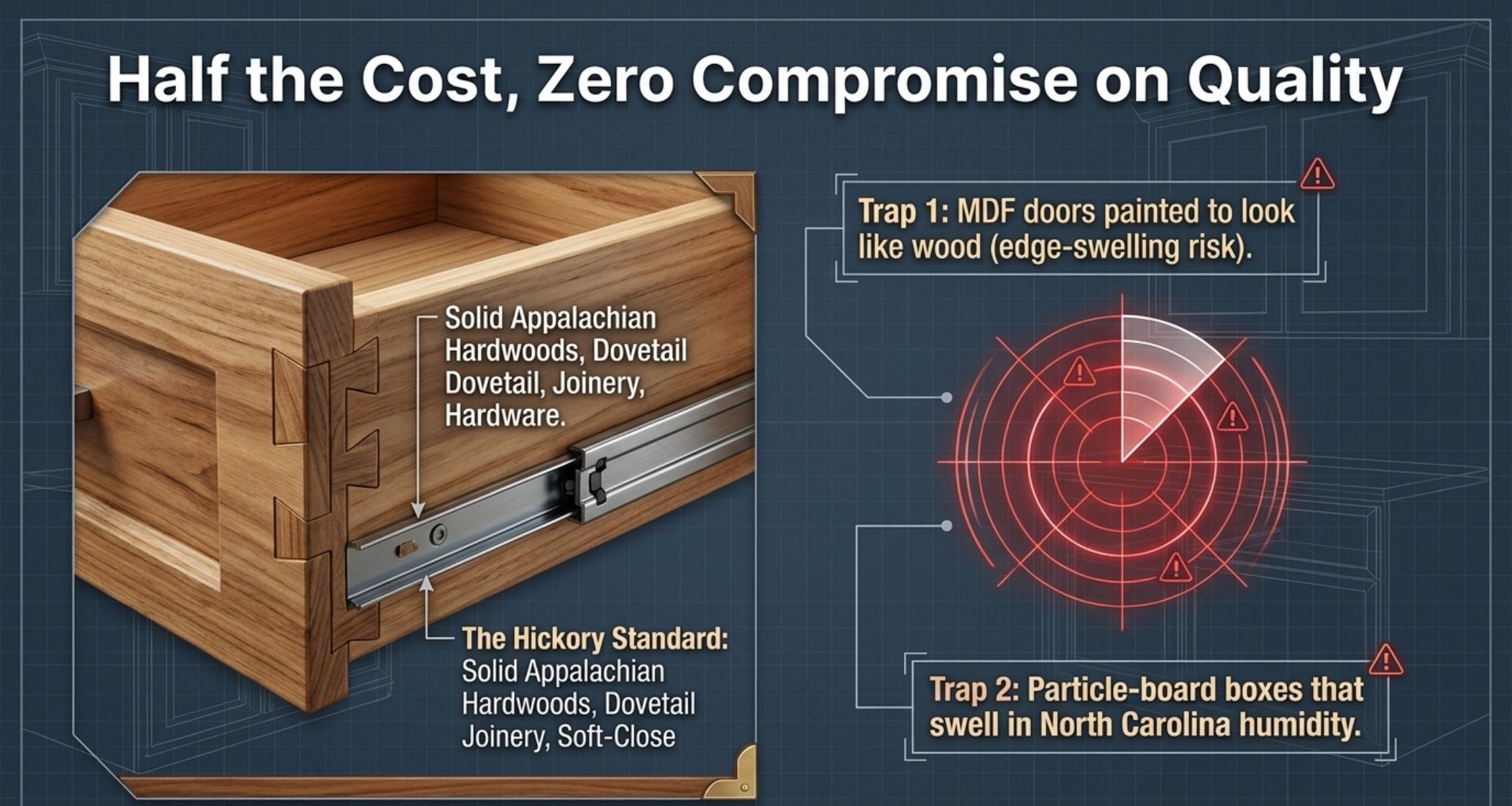
Deck baseline: avoid MDF doors painted to mimic wood - their edges will inevitably swell in humid months.
What a swelling box does to a new door
The second trap is worse, because it sits underneath the part you paid to upgrade. Particle board exposed to summer humidity acts like a sponge: the edges swell, the panel loses its dimensions, and the hinge plate loses its grip in exactly the material the door hangs from. A brand-new door on a swollen box will not stay aligned no matter how many times it is adjusted, and the installer will eventually explain the problem as "the frame moving". It is not the frame.
| Box material | Humidity behaviour | Hinge performance after swelling | Correction |
|---|---|---|---|
| Solid plywood | Breathes and adapts; holds screws | Plates stay put | None needed |
| Kiln-dried solid hardwood frames | Stable below 10% moisture content | Plates stay put; load transfers into the frame | None needed |
| Particle board | Edges swell and crumble once moisture reaches a cut edge | Plates work loose; doors drop and re-align repeatedly | Box replacement — there is no surface repair |
| MDF | Edges swell in wet zones; the finish cracks along the swelling | Hinge purchase is lost as the panel grows | Box or panel replacement |
A reface on particle-board boxes is a new facade on a structure that has already started to fail.
The cost model, with the arithmetic shown
Refacing in this market runs $6,000-$17,500 for a kitchen against $12,000-$35,000 for full replacement. The midpoints make the 50% rule exact: ($6,000 + $17,500) / 2 = $11,750, and ($12,000 + $35,000) / 2 = $23,500, so $11,750 / $23,500 = 0.50. That is the honest headline, and it is the number the substitutions eat into.
Every 10% shaved off the $11,750 midpoint is $1,175 of material that is no longer in the job, so a quote at 80% of the band is a $2,350 discount - and a redo at year five costs the full band again, which turns a $9,400 reface into $9,400 + $11,750 = $21,150 against $11,750 for doing it once to specification. In a market where cabinetry is 29-35% of a renovation budget, the correct comparison is never against the cheapest quote, it is against the cost of doing the job twice: on a $40,000 renovation the cabinetry line alone is $40,000 x 0.29 = $11,600 to $40,000 x 0.35 = $14,000.
Failure and maintenance: the truth table
The five rows below price the substitutions end to end: what each one saves at order, when it fails, and what the correction costs.
| Substitution | What it saves at order | First failure window | Cost to correct | Specified alternative |
|---|---|---|---|---|
| Painted MDF door instead of solid hardwood | The largest single discount in a cheap reface | First humid summer, at the door edge | Full door replacement plus finish match | Solid Appalachian hardwood, sealed edges |
| Particle board boxes retained under new doors | Avoids carcass work entirely | First humid summer at the cut edge | Box replacement, not a re-skin | Plywood boxes, square-tested before quote |
| Unbranded glides and hinges | Small per-unit saving across every door | Year 3-8 depending on cycles | Replace each mechanism once, then again | Branded hardware with a stated cycle rating |
| Re-used toe kick and end panels | No new panels cut or finished | Visible within one season | Re-veneer or replace the exposed ends | New veneer on all exposed carcass faces |
| No condition audit before signing | Quote issued without a site check | At strip-out, once the doors are off | Scope grows mid-project; schedule slips | Written list of retained and replaced boxes |
The five rows are not independent. A quote that has quietly swapped to painted MDF doors is usually the same quote that left particle-board boxes in place and re-used hardware, because all the changes come from one instinct: reduce the cost of the parts that are hard to inspect.
How to detect both traps before you sign
Four questions close the gap, and a straight installer answers all four without hesitating. Ask what the door substrate is, not what the door finish is. Ask whether the retained boxes are plywood or composite, and ask to see a cut edge on an actual retained box rather than a showroom sample.
| Question | Good answer | Warning answer | How to verify |
|---|---|---|---|
| What is the door made of? | Solid hardwood, or hardwood-edged plywood core | “It is a painted finish” | Ask to see a cut edge, not a sample |
| Are the retained boxes plywood? | Yes — plywood throughout | “Moisture-resistant” without a substrate name | Look inside a base cabinet at a cut edge |
| What are the drawer boxes? | Solid wood dovetail | “Solid wood” with no joinery detail | Open a drawer and look at the corner joint |
| What hardware is included? | Named brand; soft-close hinges and full-extension under-mount glides | “Soft-close included” with no brand | Ask for the model number on the quote |
If a quote does not survive these questions in writing it has not been specified, and one warning answer is a strong signal that the other lines are coming.
Calibrated to Hickory and the Catawba Valley
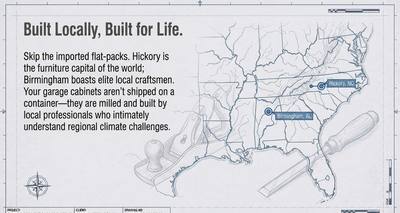
The local standard the deck describes is not exotic, and the region is the reason it exists. Catawba County's first furniture factory opened in 1902, and the state's commerce department still calls Hickory the furniture capital of the world, with triple the national average of furniture-manufacturing activity and the largest furniture workforce in the country. Solid Appalachian hardwood doors, dovetail joinery and soft-close hardware are the vocabulary of that trade - a benchmark a local shop can meet because it has been building case goods here for over a century.
Humidity is the other half of the calibration, and it is why MDF edges and particle-board cores fail here rather than somewhere drier. Hickory averages 67% relative humidity, peaks near 74% in August, and holds a muggy window of roughly four months from late May into September. A reface done in October looks perfect through the winter and shows its first edge swelling the following summer, which is why the material question has to be answered at quote stage: kiln-dried stock below 10% moisture content, plywood boxes, and every cut edge sealed. Local material sourcing shortens the correction loop if one does fail - a valley shop can re-make a door to pattern, where an imported reface kit waits on a shipment.
Decision matrix: choose the reface scope by the boxes you already own
- Choose a full reface if the boxes are square and dry, the layout works, and only the doors, fronts and hardware are dated - that is the genuine $11,750 versus $23,500 case.
- Choose partial replacement plus refacing if two or three boxes have swelled or racked; the honest comparison then sits nearer 70% of a rebuild, which is 0.70 x $23,500 = $16,450.
- Choose full replacement if the layout is the problem, because a reface cannot change the shape of a kitchen.
- Choose hardwood doors and plywood boxes if you want the reface to still be visually current in ten years rather than five.
- Reject any quote if it cannot state the door substrate, the box substrate, the drawer joinery and the hardware brand in writing - one missing answer is a signal about the other three.
Contractor spec handoff checklist
Send this to every refacing quote and ask for a written answer against each line; the site's own specification checklist covers the same ground for a full build.
- Door substrate named, with the cut-edge treatment specified as banded, sealed or painted.
- Box substrate named for every retained unit, checked with a square before quoting.
- Written list of which boxes are retained and which are replaced, with the replacement priced separately.
- Drawer box material and joinery confirmed, with a dovetail or dowel standard stated.
- Hardware brand and model for hinges and glides, with cycle rating where available.
- Veneer scope: exposed carcass faces, end panels and toe kick all covered or replaced.
- Moisture content of supplied stock at delivery, and the on-site storage and acclimatisation period.
- Touch-up kit included with the stain or paint code recorded for future edge repair.
Price the job on that specification and the quotes compete on materials rather than on how much of the specification each one quietly removed.
Sources
Figures in this article come from the "The 50% Rule" refacing deck slides (MDF edge-swelling trap, particle-board boxes that swell in North Carolina humidity, the Hickory standard of solid Appalachian hardwoods with dovetail joinery and soft-close hardware), the site's own refacing and replacement bands ($6,000-$17,500 against $12,000-$35,000) and the 29-35% cabinetry share of a renovation budget, Hickory climate normals (67% mean relative humidity, 74% August peak, ~4-month muggy window), and North Carolina Department of Commerce / Catawba County furniture-industry reporting.
Ready to Talk to a Local Cabinet Pro?
Get free, no-obligation quotes from pre-vetted Hickory cabinet professionals — licensing, insurance and references checked before you are introduced.
Get Matched in Hickory →