Verdict: refacing is a surface project with a structural condition
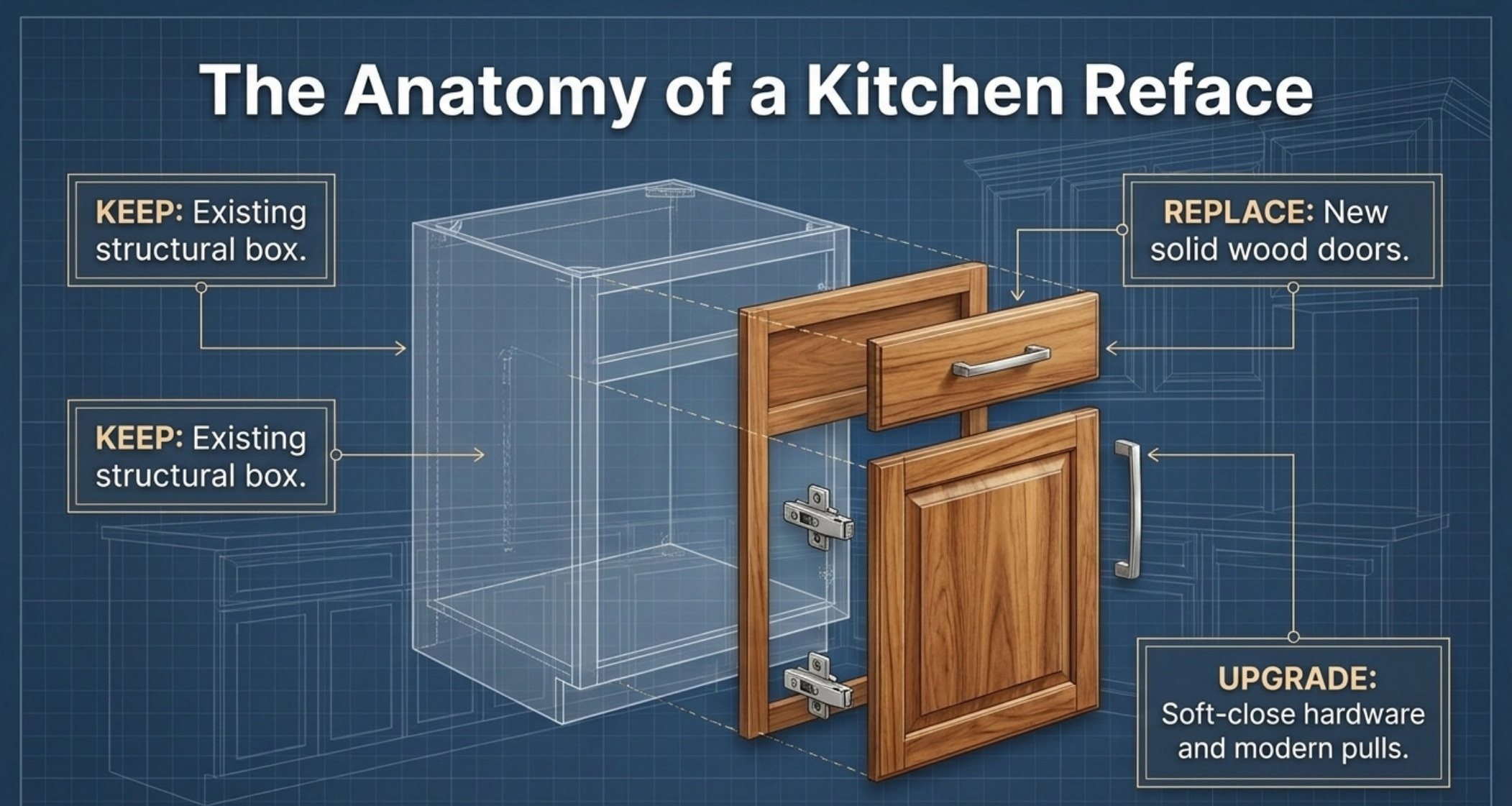
The 50% rule is usually explained as "new doors instead of new cabinets". The accurate version is narrower and more useful: refacing keeps the existing structural box and replaces or covers everything attached to it. That means new doors, new drawer fronts, new veneer on exposed carcass faces, new end panels, new toe kick and new hardware - all in 3-5 days for roughly half the cost of a full replacement. It works only when the thing being kept is genuinely worth keeping, which is why the condition audit comes before the quote, not after the deposit. If you have been weighing up time to buy kitchen cabinets for a home around Hickory, NC, this guide covers how it actually works, what it tends to cost, and where the results usually fall short.
What is kept, what is replaced, and what each line weighs
The component list is short and each line has a reason for being on the keep side or the replace side. Read it as a scope document rather than a description, because the cost of the job is set by which lines move.
| Component | Keep / replace / upgrade | Why | Cost weight |
|---|---|---|---|
| Structural cabinet box | Keep | It is square, sound and already fitted to the room | 0% — this is the saving |
| Doors and drawer fronts | Replace | The entire visible aesthetic lives here | The largest line in most refaces |
| Exposed carcass faces and end panels | Cover with veneer or new panels | A new door on a scuffed frame looks like a new door on a scuffed frame | Moderate |
| Drawer boxes | Keep if dovetailed; replace if stapled | Dovetail boxes outlast the doors; glued corners will not | Optional, but the right place to upgrade |
| Hinges and drawer glides | Upgrade | Soft-close is the difference between dated and refreshed | Small, high perceptual return |
| Filler panels, toe kick, trim | Replace | Tiny components carry a disproportionate amount of “old” | Low |
Deck baseline: refacing keeps the existing structural box and replaces the doors, hardware and drawer fronts in the same pass.
The condition that makes half-price honest
The 50% saving is only honest when the retained boxes are sound. If two base units have swelled and one run has racked, the correct comparison is not refacing against full replacement - it is partial replacement plus refacing, and that combination often lands closer to 70% of a full rebuild. Ask the installer to state in writing which boxes are being retained, which are being replaced, and what standard the retained boxes were tested against. A reface that quietly re-skins a failing carcass is the most expensive kind of cheap, because the failure is trapped behind a new facade.
| Condition | How to check it | What happens if you reface anyway |
|---|---|---|
| Boxes out of square or racked | Framing square against interior corners; gaps mean racked | Doors will not hang evenly and glides bind |
| Swollen or water-damaged panels | Look at sink bases, dishwasher bays and the toe-kick line | New fronts go onto a carcass that keeps moving and failing |
| Loose or stripped hinge plates | Open and close every door and feel for movement at the plate | New doors pull out of the same hole |
| Layout that does not work | Walk the kitchen and name what it tries to do badly | You have paid to keep the problem, just nicer-looking |
Anything that fails the audit is a box to replace, not to re-skin. The surface scope is fixed by the number of doors and fronts; the structural scope is set by the audit.
The cost model, with the arithmetic shown
Use the market's own bands and the 50% rule becomes exact rather than rhetorical. Refacing runs $6,000-$17,500 for a kitchen; full replacement runs $12,000-$35,000. The midpoints are ($6,000 + $17,500) / 2 = $11,750 and ($12,000 + $35,000) / 2 = $23,500, so $11,750 / $23,500 = 0.50. Half price is real - but only on the lines the audit cleared.
Price the exception the same way. Two swollen base units plus a reface lands nearer 70% of a rebuild: 0.70 x $23,500 = $16,450, which is $4,700 more than the clean reface and still $7,050 below a full replacement. That is the honest middle path, and it is the number to ask for when the audit finds damage. Where the whole layout is wrong, no surface scope applies at all, and the comparison reverts to the full band.
Where the money goes between the two routes
| Line | Economy choice | Durable choice | Effect |
|---|---|---|---|
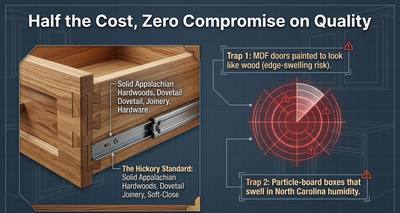
| Door construction | Painted MDF doors | Solid Appalachian hardwood doors, dovetailed where required | The single biggest swing in price and lifespan |
| Veneer coverage | Only the faces that are obviously exposed | Every visible carcass face and end panel | Hidden gaps read as unfinished at hand-over |
| Hardware | Re-use existing hinges and glides | Soft-close hinges plus under-mount full-extension glides | Cheapest way to make a reface feel like a new kitchen |
| Drawer boxes | Keep whatever is there | Replace stapled boxes with dovetail construction | The load-bearing part buyers never see until it breaks |
Three lines carry the difference in service life, and none of them is decided by price alone: the drawer box outlives the doors or it does not, the glide is branded or it is not, and the hardware is replaced on schedule or re-used until it fails.
Failure and maintenance: the truth table
The six rows below are what actually fails after a reface, and whether the failure traces back to a box that was retained or one that was replaced.
| What fails next | When it appears | What causes it | If the box was retained | If the box was replaced |
|---|---|---|---|---|
| Hinge plate loses grip | Year 3-6 after swelling | Fasteners set into a swollen composite core | Door drops; adjustment stops working; box replacement needed | Re-drilled or through-bolted at the bench |
| Door edge swells | First humid summer | An unsealed cut edge on a composite or MDF door | The new door fails and the old box gets blamed | Replacement door made to the same pattern |
| Box racking shows at the door gap | After the first season of use | A box that was already out of square before refacing | Doors never align cleanly, however often adjusted | New box squared in place |
| Toe kick and end panel delaminate | Within one season | Re-used panels with a failed factory finish | Visible edge failure beside new doors | New panels cut and sealed |
| Glide loses soft-close | Year 5-8, past 20,000 cycles | Unbranded mechanism used to hold the price down | Glide pair replaced; drawer box may follow | Branded glide replaced by model number |
| Punch list never closes | Weeks after hand-over | Scope that was not written down before work started | Repeated call-backs; goodwill erodes | Written retained/replaced list settled the scope |
Five of the six failures trace back to a decision made before the doors came off, which is why the audit is the cheapest hour in a refacing project.
Calibrated to Hickory and the Catawba Valley
The material standard this valley expects is set by its own history. Catawba County's first furniture factory opened in 1902, and North Carolina's commerce department still describes Hickory as the furniture capital of the world, with triple the national average of furniture-manufacturing activity and the largest furniture workforce in the country. Solid Appalachian hardwood doors, dovetail drawer boxes and soft-close hardware are the vocabulary of that trade, and they are the three lines that separate a reface still visually current in ten years from one that needs redoing in five.
Humidity decides which of those lines matters here. Hickory averages 67% relative humidity, peaks near 74% in August, and holds a muggy window of about four months from late May into September, so a door and the box it hangs from are both cycling through that band every year. A reface done to a kiln-dried stock standard - below 10% moisture content - with plywood retained boxes and every cut edge sealed is engineered for that cycle. Local material sourcing matters for the same reason: if one retained box does fail in year four, a shop in the valley re-makes the panel to pattern, where a kit-based reface waits on a delivery.
Decision matrix: choose the scope by the audit result
- Choose a clean reface if every retained box is square, dry and sound - that is the genuine $11,750 against $23,500 case.
- Choose partial replacement plus refacing if two or three units have swelled or racked; the honest comparison is then 0.70 x $23,500 = $16,450.
- Choose full replacement if the layout is the problem or more than a third of the boxes fail the audit, because the surface scope then carries a structural bill.
- Choose to replace the drawer boxes if the corners are stapled rather than dovetailed - they outlast the doors you are about to buy, or they do not.
- Do not sign if the quote does not list which boxes are retained and which are replaced, in writing, before work starts.
Contractor spec handoff checklist
Hand this to every refacing shop and ask for the answers back on the quote itself; the site's own refacing ROI calculator covers the same decision from the cost side.
- Written retained/replaced box list, produced from a square-and-torch audit rather than a visual look.
- Door and drawer-front substrate named, with the cut-edge treatment specified.
- Veneer scope confirmed for exposed carcass faces, end panels and toe kick.
- Drawer box material and joinery stated, with dovetail or dowel as the standard.
- Hardware brand and model for hinges and glides, with cycle rating where published.
- Moisture content of supplied stock at delivery and the acclimatisation period on site.
- Sealed base and toe kick detail, so the retained boxes are not re-exposed at the floor line.
- Touch-up kit included, with the stain or paint code recorded for later edge repair.
Price the job on that specification and the reface quotes you receive become comparable on scope rather than on how much of the audit each one skipped.
Sources
Figures in this article come from the "The 50% Rule" refacing deck slides (the keep/replace anatomy of a reface, the MDF edge and particle-board box traps, the Hickory standard of solid Appalachian hardwoods with dovetail joinery and soft-close hardware), the site's own refacing and replacement bands ($6,000-$17,500 against $12,000-$35,000), Hickory climate normals (67% mean relative humidity, 74% August peak, ~4-month muggy window), and North Carolina Department of Commerce / Catawba County furniture-industry reporting.
Ready to Talk to a Local Cabinet Pro?
Get free, no-obligation quotes from pre-vetted Hickory cabinet professionals — licensing, insurance and references checked before you are introduced.
Get Matched in Hickory →